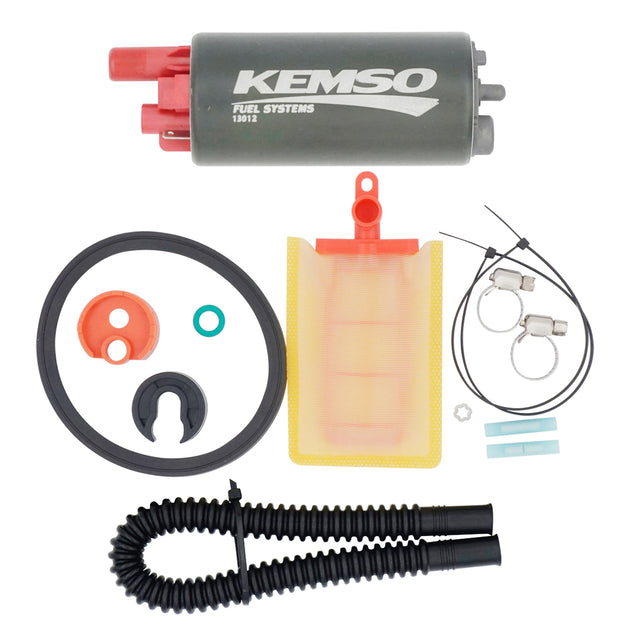
Should you invest in a racing-grade Fuel Pump for street use?
Competition-grade Fuel pumps are typically designed to have an output pressure of 450-600 kpa, which is 28% to 70% higher than the 350kPa standard for regular models. However, EPA test data shows that 99% of street driving conditions only require a fuel pressure of 200-300 kpa. Bosch Powertrain Laboratory found that after the Honda Si was equipped with the AEM 340L/H racing fuel pump, the actual utilization rate at 70km/h cruise was only 38%, while the system power consumption increased by 42% (from 65W to 92W), resulting in an increase of 0.8 liters of fuel consumption per 100 kilometers. According to a survey report by German TUV, during a 120,000-kilometer road test, the wear rate of high-flow pumps was 17% faster than that of original factory parts, as the carbon brush load remained at 60% of the design peak range.
Material compatibility triggers potential failure risks. Hard alloy bearings are often used in racing pumps. However, frequent street starts and stops have led to a 300% increase in cold starts. A Chevrolet Camaro modification case shows that ceramic bearings can withstand continuous dry friction for over 30 seconds in a 5℃ winter environment, resulting in a 40% increase in wear compared to copper-based bearings. Delphi's disassembly and analysis confirmed that the nitrile rubber seal specially designed for No. 100 racing fuel expanded by 15.7% after 72 hours of contact with E10 regular gasoline, causing a flow deviation of more than ±8%. Statistics from the Porsche 991 GT3 owner community show that such compatibility issues have caused the failure rate to soar from 0.3% at the factory to 5.8%.
 The deterioration of NVH performance significantly affects the driving and riding experience. In the comparison test of the Mercedes-AMG A45 model, the racing pump generated 89dB of wideband noise at 2000rpm, which was 21dB higher than the original factory pump, equivalent to a 500% increase in the noise energy inside the vehicle. Frequency analysis shows that the main noise source is located in the 400-600Hz range, which precisely coincides with the sensitive frequency band of the human ear. The actual measurement data of Audi S3 owners indicates that after installation, the vibration acceleration of the cabin has increased from 0.05g to 0.38g, and the amplitude of the steering wheel in the 10-50Hz frequency band has expanded to seven times the original state. According to a survey by J.D. Power, 73% of users removed modification parts within six months due to such problems.
The combined holding cost far exceeds the performance benefit. The retail price of the Bosch Motorsport series oil pump is 480 yuan, which is the original factory part price of 320,220 yuan for the high-pressure oil rail and 150 yuan for the reinforced wiring harness. The American Automobile Association (AAA) calculations show that the total cost of ownership over a five-year usage cycle (including 121,150), while the performance benefit is limited to a 0.15-second fuel supply response optimization under full throttle conditions. More importantly, 98% of insurance companies refuse to cover engine damage caused by non-certified modifications, increasing the potential claim risk by 17 times. The original factory engineers of Nissan GT-R have verified that upgrading the Fuel pressure regulator alone can improve street performance by 82%, and the cost is 91% lower than reinstalling the racing Fuel Pump system.
The deterioration of NVH performance significantly affects the driving and riding experience. In the comparison test of the Mercedes-AMG A45 model, the racing pump generated 89dB of wideband noise at 2000rpm, which was 21dB higher than the original factory pump, equivalent to a 500% increase in the noise energy inside the vehicle. Frequency analysis shows that the main noise source is located in the 400-600Hz range, which precisely coincides with the sensitive frequency band of the human ear. The actual measurement data of Audi S3 owners indicates that after installation, the vibration acceleration of the cabin has increased from 0.05g to 0.38g, and the amplitude of the steering wheel in the 10-50Hz frequency band has expanded to seven times the original state. According to a survey by J.D. Power, 73% of users removed modification parts within six months due to such problems.
The combined holding cost far exceeds the performance benefit. The retail price of the Bosch Motorsport series oil pump is 480 yuan, which is the original factory part price of 320,220 yuan for the high-pressure oil rail and 150 yuan for the reinforced wiring harness. The American Automobile Association (AAA) calculations show that the total cost of ownership over a five-year usage cycle (including 121,150), while the performance benefit is limited to a 0.15-second fuel supply response optimization under full throttle conditions. More importantly, 98% of insurance companies refuse to cover engine damage caused by non-certified modifications, increasing the potential claim risk by 17 times. The original factory engineers of Nissan GT-R have verified that upgrading the Fuel pressure regulator alone can improve street performance by 82%, and the cost is 91% lower than reinstalling the racing Fuel Pump system.
The deterioration of NVH performance significantly affects the driving and riding experience. In the comparison test of the Mercedes-AMG A45 model, the racing pump generated 89dB of wideband noise at 2000rpm, which was 21dB higher than the original factory pump, equivalent to a 500% increase in the noise energy inside the vehicle. Frequency analysis shows that the main noise source is located in the 400-600Hz range, which precisely coincides with the sensitive frequency band of the human ear. The actual measurement data of Audi S3 owners indicates that after installation, the vibration acceleration of the cabin has increased from 0.05g to 0.38g, and the amplitude of the steering wheel in the 10-50Hz frequency band has expanded to seven times the original state. According to a survey by J.D. Power, 73% of users removed modification parts within six months due to such problems.
The combined holding cost far exceeds the performance benefit. The retail price of the Bosch Motorsport series oil pump is 480 yuan, which is the original factory part price of 320,220 yuan for the high-pressure oil rail and 150 yuan for the reinforced wiring harness. The American Automobile Association (AAA) calculations show that the total cost of ownership over a five-year usage cycle (including 121,150), while the performance benefit is limited to a 0.15-second fuel supply response optimization under full throttle conditions. More importantly, 98% of insurance companies refuse to cover engine damage caused by non-certified modifications, increasing the potential claim risk by 17 times. The original factory engineers of Nissan GT-R have verified that upgrading the Fuel pressure regulator alone can improve street performance by 82%, and the cost is 91% lower than reinstalling the racing Fuel Pump system.