Risk Review: Sourcing particle board for furniture production
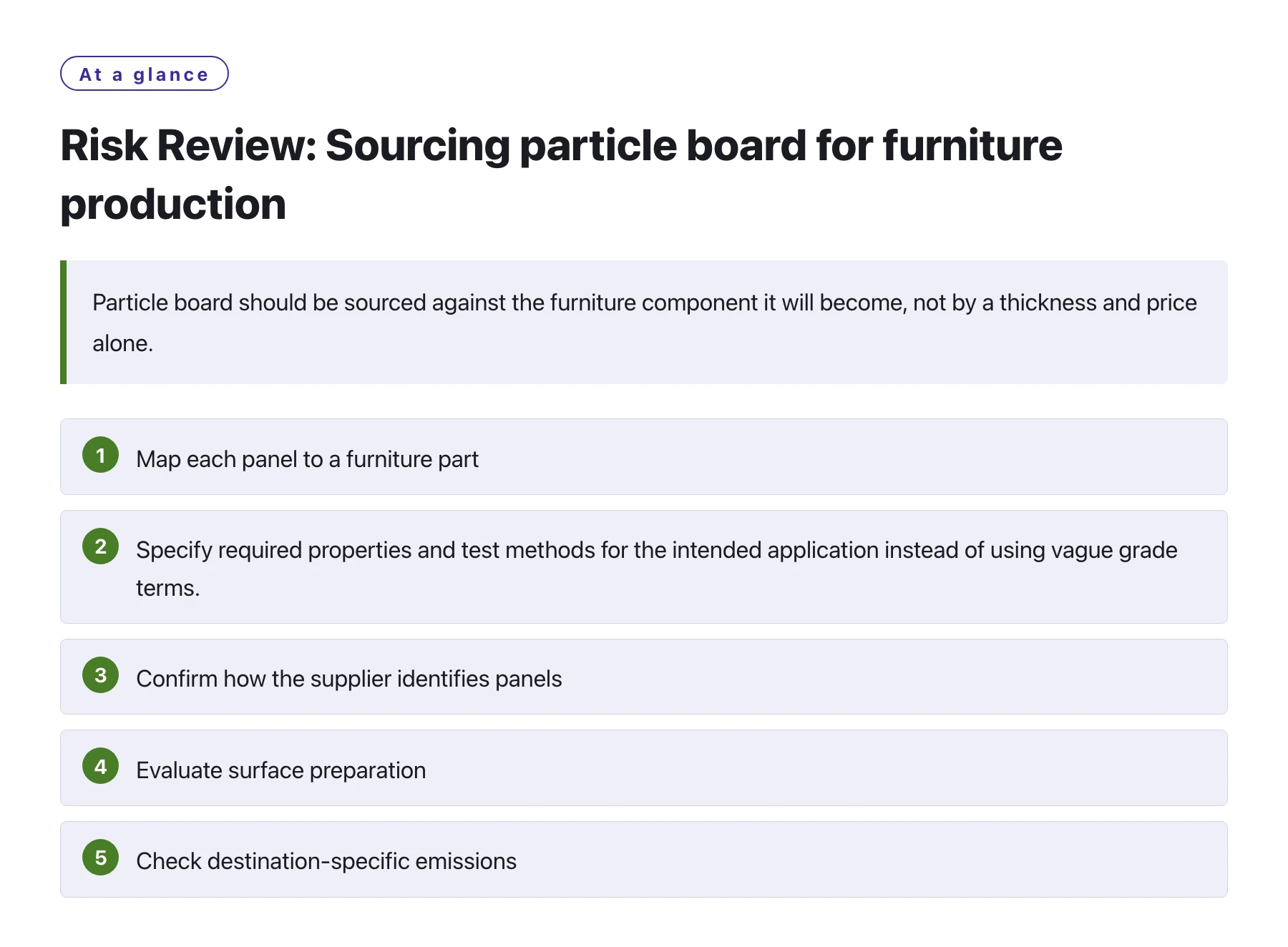
Particle board should be sourced against the furniture component it will become, not by a thickness and price alone. The required panel, surface, edge, machining, moisture exposure, fastening, and documentation depend on the design and destination. Buyers should define the performance questions for each use, confirm the supplier's product and manufacturing scope, and connect test evidence and labeling to the exact panels or finished goods in the order.
Key takeaways
- Map each panel to a furniture part, drawing revision, dimensions, edge treatment, and finish.
- Specify required properties and test methods for the intended application instead of using vague grade terms.
- Confirm how the supplier identifies panels, production batches, material inputs, and approved revisions.
- Evaluate surface preparation, machining, fastener details, edge sealing, packaging, and storage together.
- Check destination-specific emissions, labeling, testing, and import documentation with qualified reviewers.
- Keep the approved sample and production inspection criteria tied to the exact order lot.
A panel used inside a cabinet, a structural furniture component, a shelf, and a laminated finished part may face different loads, edges, surfaces, and environmental conditions. A supplier quote that says only 'particle board' leaves room for different assumptions about material, thickness, density, surface quality, and testing. A useful review starts with the part's function and works backward to a measurable panel specification.
Define the panel by its role in the furniture
Create a bill of materials or panel schedule that connects each board to a furniture part, product code, drawing, dimensions, quantity, surface, and edge treatment. Note whether the panel will be visible, laminated, veneered, painted, machined, joined, or concealed. Identify loads and support conditions that the design owner considers important, and state how the finished component will be checked.
Specify thickness and dimensional tolerances in a way that matches the assembly. If the furniture uses routed features, hardware, dowels, screws, or edge banding, include the relevant hole locations, edge distances, machining assumptions, and fit checks. A panel may meet a nominal thickness and still create assembly issues if the machining or edge treatment is not aligned with the approved drawing.
Use named requirements instead of broad terms such as furniture grade, premium, or moisture resistant without a corresponding standard or performance criterion. If a supplier proposes a classification or grade, ask for its definition and the test or product standard behind it. Have the design or engineering reviewer decide whether it matches the intended use.
Review core, surface, and edge as one system
Ask how the supplier controls the panel's construction, thickness, density or other specified properties, surface flatness, and consistency across production lots. The finished furniture may depend on a coating, laminate, veneer, adhesive, or edge band that changes the panel's performance and appearance. Review the panel and finish combination together rather than treating each material as unrelated.
For visible components, approve a reference sample that includes the actual surface, color, texture, edge, and finish. Record the board or finish identifier and compare under agreed viewing conditions. One small cut sample may not show full-sheet variation, directional grain, seam behavior, or the appearance of a large panel in a room; decide whether a larger mock-up or multiple lot samples are needed.
If the component is exposed to humidity, cleaning, or occasional spills, define the expected condition and ask which product-specific evidence supports suitability. Do not assume an informal 'moisture resistant' label establishes performance for every environment. Likewise, do not substitute a panel or edge treatment without checking how machining, sealing, bonding, and maintenance may change.
Connect machining and fasteners to the specification
Review how the panel will be cut, drilled, routed, and assembled. Confirm which party owns the final nesting plan and machining file, what edge finish is visible, how exposed edges are protected, and which dimensions are checked after processing. A board can conform as a raw sheet while a finished furniture part misses the required hole position or assembly clearance.
If screw holding or hardware performance matters, specify the relevant test or assembly check and identify the edge or face condition to be evaluated. The result may depend on the panel, fastener, pilot hole, insertion method, and component geometry. Ask the technical reviewer to define the test conditions rather than asking a factory to confirm a generic claim about strength.
Request records that link machining or assembly checks to the product revision and production batch. When a supplier uses a different tool, panel source, adhesive, or edge material, ask whether the change affects the approved sample, test results, or finished dimensions.
Check emissions and market documentation
Determine the destination market and ask a qualified reviewer which composite-wood requirements apply to the panel and to finished furniture containing it. For the United States, EPA's TSCA Title VI framework covers particleboard along with other composite-wood products and includes provisions for testing, labeling, recordkeeping, and import certification; EPA's importer guide is intended to help importers, distributors, and retailers understand the rule.[1] Confirm current obligations and product scope for the actual transaction with the responsible importer or regulatory adviser.
Request evidence tied to the exact product, manufacturing site, and relevant production period. Check the supplier or mill identity, product category, certification or test status, label information, and chain linking the document to the panels or finished goods. A document for another plant, material, or product family may not cover the order. Keep the buyer's purchase records and any required import records organized with the shipment and item identifiers.
EPA proposed an update to incorporated consensus standards in February 2026, so do not treat a dated supplier checklist as the final word on the current test-method references. Verify the applicable rules and standards at the time of import with an appropriate reviewer, especially when a supplier cites an older edition or a foreign-market certificate.
Plan production checks and lot identification
Define which panel characteristics need incoming, in-process, or final checks. A buyer may need to verify dimensions, surface appearance, moisture condition, machining, edge quality, labels, or specified laboratory results. State the test method, sample selection approach, lot definition, acceptance limit, record format, and response to a failed result. Use a method appropriate to the product and decision rather than assuming a single inspection plan covers every property.
Keep panel lots identifiable through fabrication. Agree how the supplier marks or records the mill, production date, batch, and finished furniture components that use each lot. If a defect is found in finished goods, this traceability can help establish which panels and shipments need review. Ask who maintains the records and how long they remain available under the project and market requirements.
For appearance variation, define how boards are selected for comparison and whether panels from different lots may be mixed in one furniture set. If the room design requires a consistent visual match, consider sequencing panels by batch or assigning a documented selection process. A reference sample alone does not describe how a large quantity will be sorted or installed.
Protect the panels through packing, storage, and delivery
Specify sheet or component packaging, corner protection, moisture barriers where needed, labels, stack orientation, and handling instructions. Ask for package dimensions and weights so the warehouse and transport plan can accommodate the goods. Confirm whether panels arrive as raw sheets or finished furniture parts and which condition must be protected during transit and staging.
Set receiving checks for package condition, labels, quantities, and visible damage. Identify how a damaged or mismatched package is quarantined and who decides whether it may be used. Keep transport damage observations separate from a later material-performance result, and preserve photos and lot identifiers when an issue is discovered.
When sourcing particle board specifications for buyers, align the technical specification with the fabrication, inspection, documentation, and delivery plan. Keep the approved drawing and sample available to the factory and receiving team so the same requirements follow the board from quote through furniture production.
Sources
Frequently asked questions
Is particle board specification just a matter of thickness?
No. The component's function, surface, edge, machining, fastening, environment, finish, and destination requirements may all affect the specification and evidence needed.
Does a supplier certificate automatically cover finished furniture?
Not necessarily. Confirm the document's product scope, manufacturer, site, lot or period, and whether it applies to panels or finished goods under the applicable market rules.
What should be checked in a particle-board sample?
Review the characteristics relevant to the part, such as dimensions, surface, finish, edge, machining, and assembly fit. Use a product-specific test for properties that visual inspection cannot establish.
Should a buyer accept a different panel source during production?
Treat it as a controlled change. Ask how it affects specification, sample approval, testing, certification, appearance, assembly, price, and schedule, then obtain the required technical and buyer approvals.