Cold Bend Testing and Winter Installations
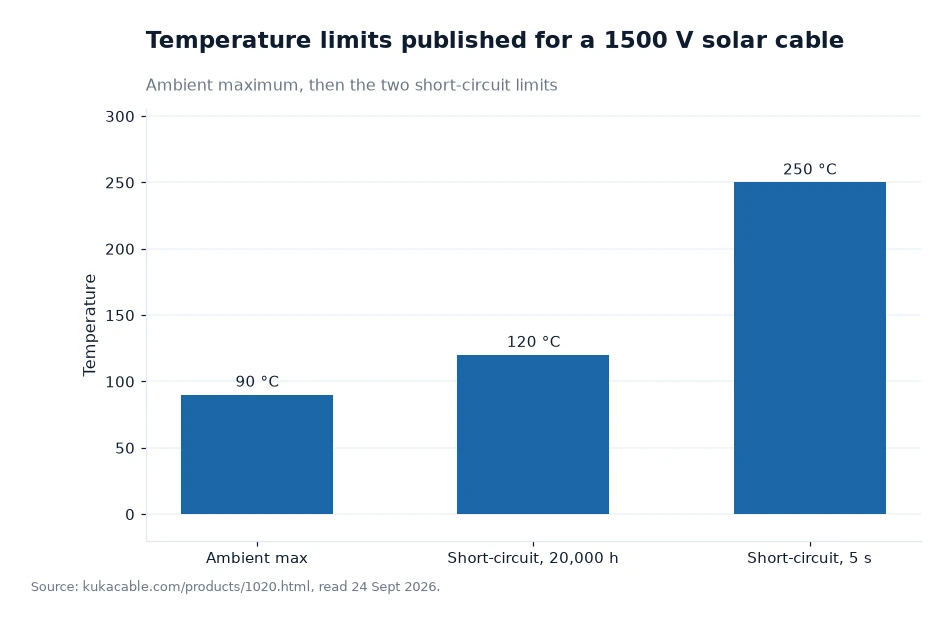
Cold is the condition that turns a flexible cable stiff, and the figure that decides whether a winter installation goes well is the low end of the published ambient window: −40 °C for KUKA CABLE solar cables. The manufacturer's own test list names a cable cold bending test and cold elongation testing, so the low limit is a tested condition rather than a line on a brochure. The published window runs to +90 °C at the other end.
Key takeaways
- Published ambient window: −40 °C to +90 °C, with a cable cold bending test and cold elongation testing on the test list.
- The conductor stays tinned copper, class 5 flexible to IEC 60228, with 84 strands of 0.29 mm in the 6 mm² size.
- Short-circuit limits: +120 °C for 20,000 hours, and +250 °C held for five seconds.
- Bending radius is 4× the outer diameter, which is 22 mm on the 5.5 mm 4 mm² build (author's arithmetic).
What the published low-temperature limit covers
The −40 °C figure appears on the 1500 V solar cable page as the bottom of the ambient temperature window. The site does not publish a separate storage temperature or a minimum installation temperature, so the ambient window is the only published figure to work to, and a project that needs a tighter site limit has to ask for it.
A window is not a recommendation. Cable that has spent a night on a pallet behaves differently from cable that came out of a warm store, and the published limit describes what the construction has been tested to withstand rather than the temperature at which it is pleasant to handle.
Cold bend and cold elongation: the two tests named for winter
The published test list names a cable cold bending test and cold elongation testing among nine checks that also include water resistance, UV accelerated weathering, abrasion and tensile testing after ageing. The two cold checks ask the same question from different angles: whether a polymer that is flexible at room temperature still deforms without damage at the bottom of its published window.
They matter because the failure mode in winter is quiet. A sheath that cracks at a bend point does not fail at the moment of installation; it admits water, and the fault appears a season later as an insulation resistance reading that will not come up.
What a class 5 conductor does at low temperature
The published conductor is a class 5 flexible stranded core: 56 strands of 0.29 mm at 4 mm², 84 strands at 6 mm² and 142 strands at 10 mm². Stranding shares a bend across many small cross-sections instead of asking one solid core to take all of it, which is why the same construction that survives a tight radius on a warm day is also the one that resists work hardening in the cold.
Tinning adds a second margin. A snow-covered array melts and refreezes through the winter, and a tinned strand holds back the surface oxide that would otherwise stiffen the copper under that cycling.
Bending the cable when fingers stop working
The published rule is 4× the outer diameter. On the published diameters of 5.5 mm, 6.0 mm and 7.5 mm the minimum radii are 22 mm, 24 mm and 30 mm, worked out here by the author from the manufacturer's figures. In cold weather a hand in a glove cannot judge a 24 mm curve by feel, and a cable dragged against a sharp frame edge will find the smallest radius available.
The solar cable section gives 0.7 mm of insulation and 0.8 mm of sheath on the 1.5 mm² to 10 mm² sizes, and 0.9 mm to 1.7 mm of insulation with 0.8 mm to 1.7 mm of sheath above that. Those layers are thin enough that a nick from a frozen edge becomes an insulation fault rather than a cosmetic mark.
Ice, meltwater and the tests that run beside the cold checks
Water resistance testing appears on the same published list, and the material behind the published certificate list names an AD8 waterproofing rating and a CPR fire rating among the requirements it addresses. Both are installation-dependent: a joint that is dry in July is not automatically dry after a freeze and thaw cycle.
Sunlight still reaches a winter array, at a low angle and without the summer heat that dries a wet surface. A 2,000-hour xenon lamp test, equivalent to about 360 weathering cycles, has been arranged on the manufacturer's solar cables to simulate intense sunlight, humidity and ozone together.
What to write into a winter method statement
Four items cover most of the risk, and each one is traceable to a published figure.
- The ambient window, −40 °C to +90 °C, quoted as the tested condition rather than a working recommendation.
- The minimum bend radius for the exact size on site: 22 mm, 24 mm or 30 mm from the published diameters, with the arithmetic shown.
- The stripping depth, which follows the published 0.7 mm of insulation on the smaller sizes and the terminal's own depth.
- The bend taken at a connector, which should start clear of the crimp rather than at it.
| Published check | What it exercises | Why a winter installation cares |
|---|---|---|
| Cable cold bending test | The sheath and insulation at low temperature | Shows whether a bend at the bottom of the window cracks a layer |
| Cold elongation testing | How far the compound stretches cold | Sets the margin before a cold bend turns into a split |
| Cable tensile testing after ageing | Conductor and compound after time and heat | Separates a new cable's strength from its aged strength |
| Cable abrasion testing | The sheath against a hard edge | Frozen roof edges are the usual abrasion point |
| Water resistance test | Moisture reaching the conductor | Freeze and thaw is how a small breach becomes a fault |
| UV accelerated weather testing | Sunlight, humidity and ozone together | Low winter sun still exposes the sheath |
Worked example
Two sums are worth doing before a cold-weather install. First the bend: 4 × 6.0 mm = 24 mm for the 6 mm² size and 4 × 5.5 mm = 22 mm for the 4 mm² size, the author's arithmetic on the manufacturer's published diameters. A gloved palm is roughly 100 mm across, using the author's own estimate rather than a published figure, so the limit cannot be judged by hand and belongs on a drawing instead.
Second the UV exposure: the published 2,000-hour xenon lamp test is equated by the manufacturer to about 360 weathering cycles, which works out at 2,000 ÷ 360 ≈ 5.6 hours of lamp time per cycle — the author's division on published figures. Treat both results as test conditions, not as site guidance the site does not publish.
Frequently asked questions
Can solar cables be installed in freezing weather?
The published ambient window runs from −40 °C to +90 °C, and the manufacturer's test list includes a cable cold bending test and cold elongation testing, so the low end is a tested condition. The site publishes no separate minimum installation temperature, so a project that needs one should ask for it and keep the published bend radius of 4× the outer diameter on the drawing.
What does cold elongation testing show?
It measures how far the compound stretches at low temperature. The published elongation figures for the manufacturer's PV cable reach up to 185%, set against the TUV EN 50618 requirement of more than 125%, and cold elongation testing asks the same question at the bottom of the −40 °C to +90 °C window rather than at room temperature.
What to check before the cold season
Put the bend radius for each size on the drawing, keep the cable under cover until it is needed, and check the sheath for nicks where a run crosses a frame edge. Ask for the test report for the batch so the cold bend and water resistance results travel with the delivery, and confirm the strip length against the terminal being used. The manufacturer publishes no price, MOQ or lead time, so those stay in the enquiry while the technical checks are settled first.
Cold-bend and low-temperature values discussed here were published by the manufacturer on its own website, read by me on 24 Sept 2026[1].